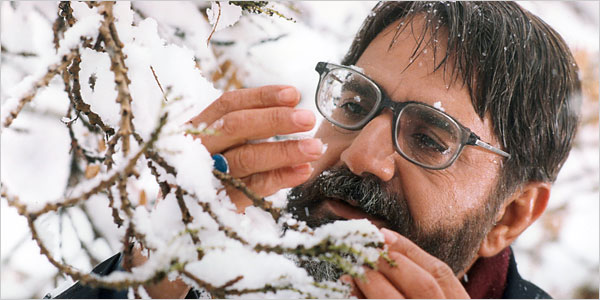
Director:
Majid Majidi is an Iranian film director, producer, and screenwriter, who started his film career as an actor. Majid Majidi’s sad, soulful film “The Willow Tree” is his second movie to explore blindness and sight on multiple levels. In his films, Majidi has touched on many themes and genres and has won numerous international awards.
Log Line:
Youssef, a blind university professor, is suddenly diagnosed with a fatal disease and must undergo treatment in France. Back home, will he find the life he had before?
Conflicts:
Impossible goal:
Youssef is deprived of a beautiful blessing of sight. But he is seen content with his life he accepts his life as it is and tries to enjoy every bit of it. Until one day, he is diagnosed with cancer. Upon such news Youssef asks God for mercy.
Youssef is worried about his life, either he will be able to return to his house alive or not. But God has different plans for him. Upon reaching Paris doctors learn that Youssef’s eyes are still sensitive to light and give Youssef the hope to see again. Impossible goal is now weather Youssef will be able to see the blessing of this world or not? Weather his prayers will be answered or not? And to his luck all of his prayers are answered. But not long after Youssef regain his eyesight he starts mourning over the lost period of time, disliking his wife and his job too. And lastly to his ungratefulness he lost his sight again. But this time not to regain it EVER.
Unlikely Hero:
From the start of the movie we tend to develop a soft corner for Youssef, now it is a different thing that it starts to fade away as the story proceeds. Youssef is a 45 year who seems content with his life and is unknown to the difference between ugly and beautiful. His character is somewhat related to a baby who is content and unknown to differentiation and discrimination. His relationship with his daughter is the most beautiful and purest. Also his inability to see draws out attention towards him, the way this character is played it feels like we are living this very moment in our life and makes us sympathies with him.
Invincible Villain:
Sight is a blessing. But what if your inner self turn this blessing into a disaster? Your ungratefulness turns all the best in your life to the worst? It isn’t easy to believe but this is what happened to Youssef life, when he gained his sight he was able to see everything beautiful and he did the same. He saw pari, his uncle’s wife and then his wife. Instead of taking everything gratefully he starts questioning God for taking away the most precious years of his life.
When they say, he destroyed himself. This is what they talk about. Youssef’s character wasn’t built like this but it turns out to be so different and yet gripping.
When God takes something away from you, be grateful, because he always gives you something of much more importance.
Character Analysis:
Back-story:
Youssef is a blind man in his forties, losing his sight at the age of 8 due to an accident is a humble man living with his wife and his daughter. He teaches poetry and is a firm believer in god and writes to him and talks to him usually. He lives a peaceful live and calls his home heaven.
Appearance:
A timid hunched man in his forties usually wears sweater, glasses with a shaggy beard. Looks happy as he plays his daughter and looks like a loving husband when talks to his wife. But it this whole truth? Your appearance tells all about you? Not in this case. He looked content, satisfies and grateful. But to shock he was none.
Beliefs:
Youssef is a 46-year-old introvert Iranian intellectual whose belief in God is somehow tempered by his personal misfortune: he has been blind since the age of eight. On the surface, Youssef deals rationally with his disability but inwardly he is angry with God. Now he has a tumor beneath his right eye, and his uncle has gotten him an appointment in Paris with a special clinic for eye surgery. Just before he leaves, Youssef writes a note to God and tucks it between the pages of a volume of the Mathnawi, the mystical masterpiece by the Persian Sufi poet Rumi. The note says:
“I’m the one you deprived of the beauties of the world and who never complained. Instead of light and brightness, I lived in darkness and gloom and I didn’t protest. I found happiness and peace in this small paradise. Are all these years of suffering not enough that you now want to cause me even more suffering? Will I come back from this trip to my loving family? Will this illness bring me to my knees? To whom should I complain about what you are doing to me? I beg of you to show me more compassion. Don’t take my life away.”
Want &Need:
- Want:
Youssef a 45 year old man who is deprived of sight is content with his existence and his life is going smoothly with his daughter and wife. He could go on telling the world about his satisfied life but deep down in his heart he wants to lead a normal life, to see things and his family to not only feel the touch of his daughter but see her beautiful face.
- Need:
Youssef eventually accepts his life and tries to live a new life leaving everything behind as a newly born in this world.
Act no 1:
When Youssef is diagnosed with cancer and he is asked to move to Paris so that he can be treated under expertise care and guide. But after undergoing a number of test doctors were shocked to reveal that Youssef eyes are still sensitive to light. But there is a 50 per chance of it, he might get his eyes back or he might lose it forever. When he undergoes cornea transplant he is rested in his ward and his eyes are wrapped with a banded around them that is suppose to be removed next morning. But as Youssef is an eager man he couldn’t wait anymore and remove his banded and to that happiness he starts hobbling in hospital corridor.
Act no 2 (Life of a wanderer and a warrior):
Youssef feelings for pari are more on front page now he doesn’t like his wife doing any of his work he even tries to avoid her presence. The film is most interesting when it isn’t making connections between disparate things, focusing on Youssef’s uncertainty as he grapples with his fidelity to his past and the newfound sense of moral obligation that accompanies his ability to see, as in a later scene during which he watches a young pickpocket swipe a man’s wallet. He feels helpless when confronted with the sight of a pickpocket plying his trade. Even his scholarly writing begins to matter less.
 talkin'film